
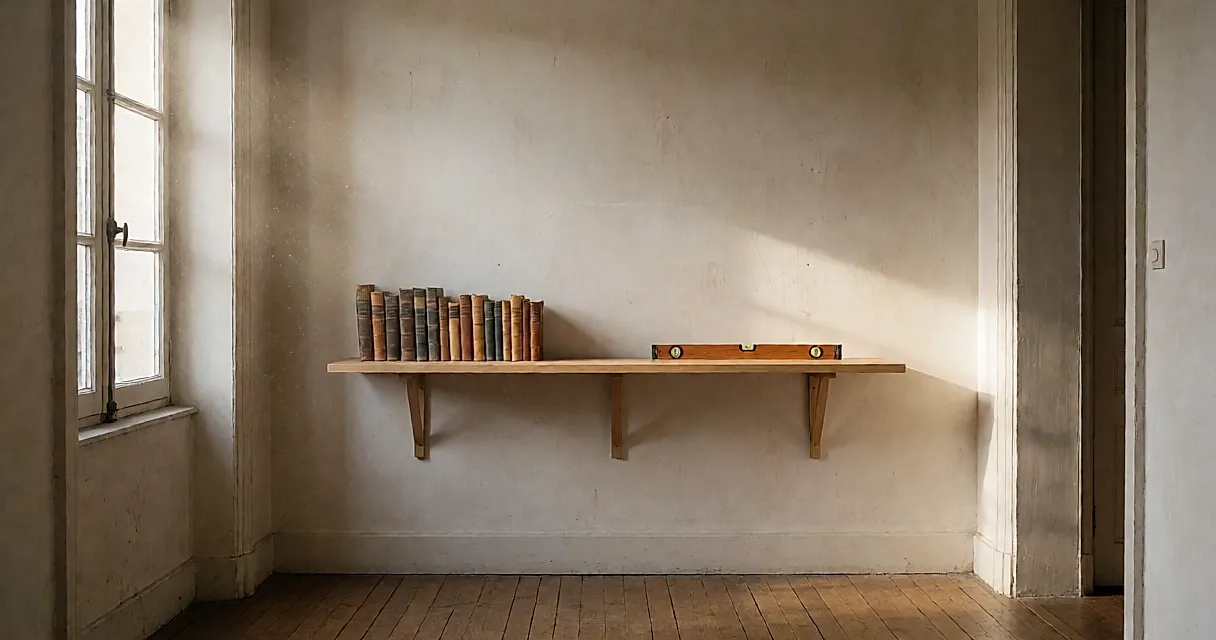
In the hallway, the pile of books has ended up on a wall shelf bought one Saturday morning, along with two packs of wall plugs. Three weeks later, the board is showing a slight slope and no one dares put the dictionary on it. The shelf itself is almost never the culprit: everything hinges on three pieces of information we look at too quickly — the quoted load, the type of fixing, and the depth. This is not about modular storage, but about how a shelf board and its fixings actually hold.
What a quoted load really tells you
A figure in kilos on the packaging is reassuring. But you need to read what it covers. A phrase such as “load per shelf, evenly distributed” only makes sense if it also states the wall type and fixing method. A quoted load without those details is incomplete information and should be treated with caution.

Distribution matters as much as the total. A load spread along the full length does not stress the fixing in the same way as a weight concentrated at the edge. A dictionary placed at the end, or a row of heavy books crammed to one side, puts a very different strain on the top screw from a shelf filled evenly. In practice, a long shelf whose quoted load gives neither distribution nor wall type should ring alarm bells: spread the books and do not rely on a single number.
A simple habit follows: spread the weight, do not stack it, put heavy volumes directly above the brackets rather than at the ends, and choose two moderately loaded shelves over one that carries everything. All the load eventually passes through a few screws; that is where the strength lies, far more than in the thickness of the melamine-faced board. A shelf packed in the middle and almost empty at the corners behaves very differently from an evenly filled one, and that imbalance is often how you can tell from across the room that a shelf has been loaded up over time without anyone thinking about it.
The wall has the final say
Before the shelf comes the wall. The choice of wall plug depends on the wall type and cannot be improvised at the moment you drill.
For the shelf itself, length, depth and bracket type are chosen together. A long, thin board held by two small brackets puts more strain on the fixings than a shorter model with better-spaced supports. Also check that the screws supplied suit the real thickness of the board: replacing them with suitable hardware costs little and changes how well it holds.
Weigh before you drill. A pile of books on the bathroom scales gives an honest rough weight. Compare it with the load quoted per shelf, leaving a comfortable margin, and remember that this figure applies to a wall in good condition — not to a wall whose construction you do not know.
Depth: the measurement you make too late
This is the parameter that causes most annoyance, because it is decided before purchase and regretted afterwards. Note the height of your books, the length available and the likely weight: these three measurements should guide your choice. A 20 cm-deep shelf takes paperbacks and a few objects; 25 to 30 cm suits most novels and coffee-table books; beyond 35 cm you are into art books, storage boxes and lever-arch files. Measure the row you actually want to put there, not the one you imagine.
Depth also affects the fixing through leverage. A bracket that is shorter than the shelf is deep puts strain on the fixings: it is anchored too close to the wall and the load acts as a cantilever. The bracket length should follow the shelf depth, within a few centimetres. And the deeper the shelf, the more it invites you to put heavy things on it — a vicious circle to consider when choosing, not after the first repaint.
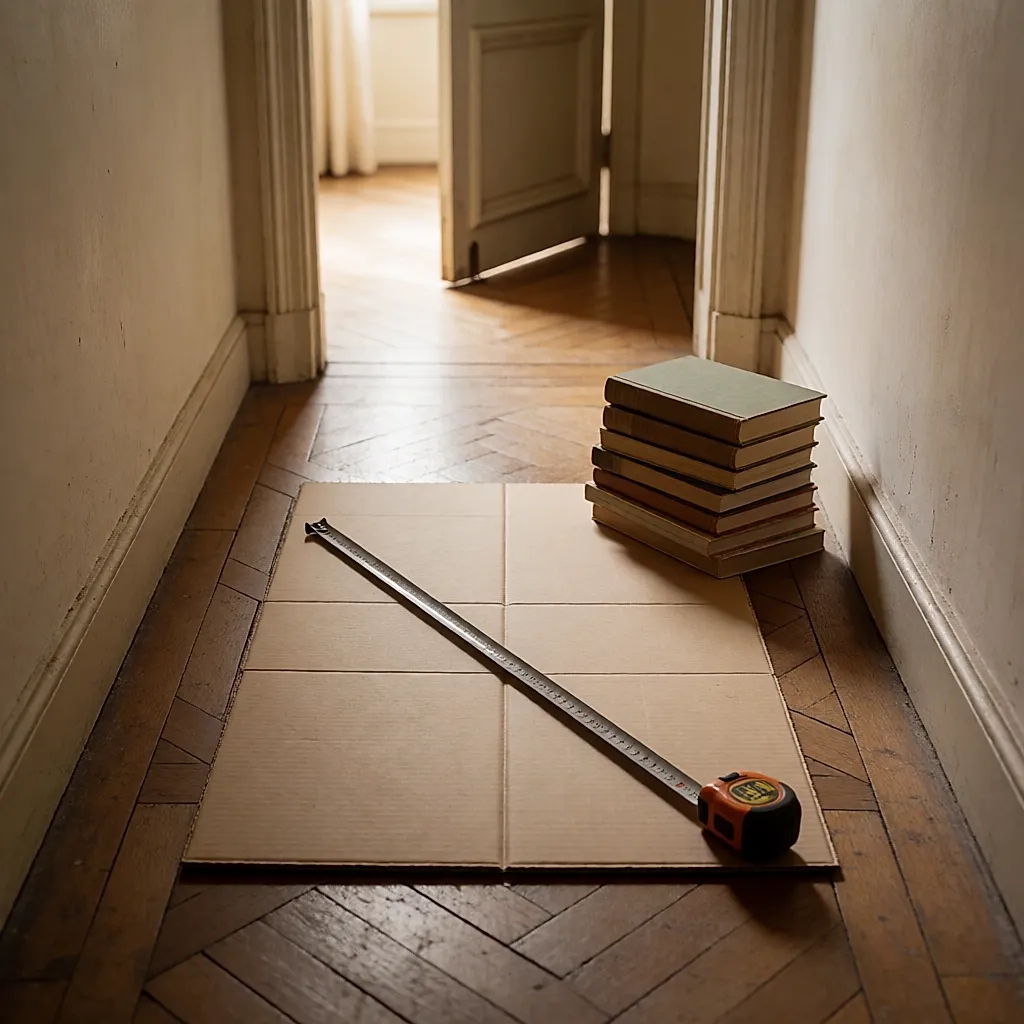
Then there is clearance. In a 90 cm-wide hallway, a 30 cm-deep shelf leaves barely enough room to pass; above a sofa, you feel the depth with your head when you stand up. A useful trick: put a cardboard template the size of the shelf on the floor in the intended spot for a day. It sounds daft, and it saves a lot of returns.
Budget
UK prices vary mainly with the hardware, the material and the length of the shelf. The ranges below are broad indicative figures, excluding promotions and bespoke work: check them in store or on a quote, as they vary by retailer and region.
Expect to pay around £15 to £40 for a simple shelf board with two metal brackets, £40 to £90 for a complete kit with shelf and fixings, £90 to £250 for solid oak or a steel bracket system, £60 to £200 for a shelf standard system, and £80 to £200 for fitting by a tradesperson, depending on the number of fixing points and access to the wall.
Where to buy: large DIY stores for entry-level shelves and fixings, specialist hardware shops for wall plugs suited to difficult walls, and a joiner for a made-to-measure shelf if the size is unusual. With a kit, the thing to watch is the supplied fixings: replacing them with wall plugs suited to your wall is often the best pound you will spend.
A shelf that does not sag is not the most expensive one: it is the one whose quoted load matches what you will actually put on it, whose wall plugs have been chosen for your wall, and whose depth was measured beforehand, not afterwards. Three checks, a few minutes of looking and measuring, and the dictionary can stay where it belongs.